


Passing your driving test for the first time takes more than learning how to steer, brake and change lanes. You need to make safe decisions, observe traffic conditions, understand road signs and demonstrate consistent control of your vehicle under pressure. For many learners, the biggest challenge is not knowing what to do but applying those skills confidently when another road user behaves unexpectedly.
Working with a professional driving instructor Surrey learners can rely on can help you identify weaknesses, practise realistic driving situations and build the habits needed for your road test. At Bayan Driving Academy, learners can focus on developing practical driving skills, understanding local road conditions and preparing for the expectations of the ICBC road test.
There is no guaranteed way to pass on your first attempt. However, with structured practice, constructive feedback and a clear preparation plan, you can improve your readiness and approach test day with greater confidence.
This guide explains how to prepare for your driving test in Surrey, which skills deserve the most attention, what mistakes to avoid and how professional instruction can support your progress.
Before booking your test, it helps to understand what the examiner is looking for. In British Columbia, the driving test is designed to assess whether you can operate a vehicle safely and independently in real traffic conditions.
The examiner is not simply checking whether you can complete individual manoeuvres. They are evaluating how you observe your surroundings, respond to hazards, follow traffic rules and make decisions throughout the drive.
Depending on the licence class and test requirements, important driving skills may include:
The exact assessment depends on the test being taken. Review the current ICBC requirements for your licence class rather than relying on outdated advice or another learner’s experience.
Surrey includes residential streets, busy intersections, commercial areas, multi-lane roads and routes where pedestrians and cyclists may be present. Each environment presents different challenges.
For example, a learner may feel comfortable driving on a quiet residential street but become uncertain when approaching a busy intersection with several turning lanes. Another learner may manage traffic well but struggle to maintain appropriate speed when the road changes from a residential area to a faster-moving route.
A structured lesson plan should address these differences instead of repeating the same familiar route every time.
Practising around Surrey can help you become familiar with different road layouts, but remember that your actual test route may vary. The goal is to develop transferable driving skills, not memorise a particular sequence of turns.
The quality of your driving practice can influence how quickly you develop safe, consistent habits. A good instructor does more than give directions. They explain why a particular action is necessary, identify patterns in your driving and help you correct mistakes before they become routine.
When looking for a professional driving instructor Surrey learners can trust, focus on teaching quality, qualifications, communication and the structure of the lessons.
Consider these factors before choosing a driving school:
Imagine that you repeatedly approach intersections too quickly. You may think the problem is braking, but the underlying issue could be that you are not scanning far enough ahead.
An effective instructor can help you recognise the earlier warning signs, reduce speed in good time and approach the intersection with better control.
This type of feedback helps you understand the cause of a mistake rather than simply correcting it once.
If you are searching for a Certified ICBC driver instructor Surrey, check the instructor’s current licence and the school’s credentials rather than relying solely on advertising or online reviews.
ICBC distinguishes between instructor licensing, driver training school licensing and approval for particular training courses. These are not interchangeable credentials. You can review the official guidance on choosing a driving school.
At Bayan Driving Academy, learners can use these criteria when discussing their training needs and deciding which lessons will best support their preparation.
Observation is one of the most important skills to practise before your road test. You need to know what is happening around your vehicle and anticipate what other road users might do next.
Good observation is active. It involves scanning the road ahead, checking mirrors regularly and looking for potential hazards before they become immediate problems.
Before changing lanes, use a consistent routine appropriate to the manoeuvre:
The order and timing of checks should match the situation. A signal does not give you the right to move if another vehicle is occupying the space.
For turns, pay particular attention to pedestrians and cyclists who may cross your path. Before turning right, check the right-side blind spot when appropriate and make sure the manoeuvre is safe.
If you focus only on the car in front of you, you may react too late when traffic slows or an obstruction appears.
Instead, scan farther along the road while remaining aware of nearby vehicles. Look for brake lights, changing traffic signals, pedestrians approaching crossings, parked vehicles and vehicles entering from side streets.
Practical example: You are approaching an intersection in Surrey and notice that the traffic ahead is slowing. Rather than waiting until you are close to the vehicle in front, ease off the accelerator early and create a safe following distance.
This demonstrates anticipation, smoother speed control and better awareness.
Intersections can be challenging because several things may happen at once. You may need to interpret traffic signals, identify pedestrians, assess gaps and choose the correct lane while controlling your speed.
During driving lessons, practise these situations until you can manage them without rushing.
As you approach an intersection:
At a stop sign, come to a complete stop at the legally appropriate position. Then scan the intersection and proceed when you have a safe opportunity.
Do not copy another driver’s behaviour if they roll through a stop sign or take an unsafe gap.
For left and right turns, your preparation should include checking the relevant traffic, signalling in good time, selecting the correct lane and adjusting speed.
Before completing the turn, watch for pedestrians and cyclists, particularly near crosswalks and intersections with limited visibility.
Avoid cutting corners, turning too widely or allowing the vehicle to drift into another lane. After completing the turn, establish the correct lane position and adjust your speed to the new road conditions.
A common mistake is treating a lane change as a movement that must happen immediately after signalling.
In reality, you may need to wait for a suitable gap. If traffic is too close or the blind spot is occupied, remain in your lane until the manoeuvre can be completed safely.
An instructor can help you practise judging gaps without making sudden steering or braking movements.
Driving at the posted speed limit does not automatically mean your speed is appropriate for every situation. You must also consider visibility, weather, road conditions, traffic and the presence of vulnerable road users.
Equally, driving unnecessarily slowly can disrupt traffic or create hazards when it is not appropriate for the conditions.
School and playground zones require particular attention to posted signs and applicable time restrictions. Learn the rules for each type of zone and follow the signs you encounter.
ICBC specifically identifies speeding in school and playground zones as a common reason for road-test failure. Its examiner guidance also recommends maintaining safe following distances and obeying posted speed limits.
Do not assume that a zone is inactive simply because you cannot see children nearby.
Leaving enough space between your vehicle and the one ahead gives you more time to respond when traffic changes.
Avoid following closely, especially in stop-and-go traffic or when visibility is reduced. If the road is wet or conditions are poor, increase your space margin as needed.
Practice tip: During each lesson, ask your instructor to observe your following distance and tell you when you are allowing too little space. Over time, learn to judge that distance independently rather than waiting for a reminder.
Parking is a skill that improves with deliberate practice. Some learners become anxious about parallel parking because they expect to complete it perfectly on the first attempt. A more useful approach is to understand the positioning, observations and steering adjustments involved.
ICBC’s road-test preparation material lists manoeuvres that may be assessed, including parallel parking, reverse stall parking, hill parking, backing up and three-point turns. The manoeuvres required can depend on the test.
Practise parallel parking in a safe, suitable location with your instructor.
Focus on:
If your first attempt is not well positioned, focus on making safe corrections where permitted rather than rushing to finish.
Reverse parking requires you to control the vehicle at low speed while monitoring the surrounding space.
Check for pedestrians, vehicles and obstacles before and during the manoeuvre. Use mirrors and direct observation as appropriate, and keep your speed low enough to stop safely.
Avoid relying on the reversing camera alone. It can help, but it does not replace checking the full area around the vehicle.
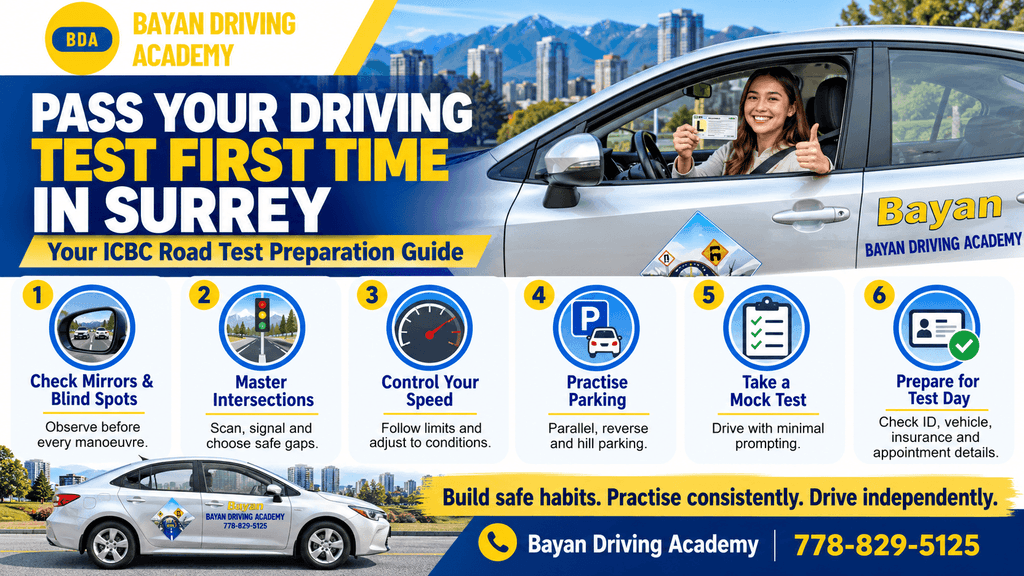
When practising hill parking, learn the appropriate vehicle positioning, parking-brake use and wheel direction for the circumstances. Your instructor should explain the correct procedure for the road layout and vehicle.
For a three-point turn, practise assessing the available space, checking traffic in both directions and completing each movement without rushing.
The objective is not simply to complete the manoeuvre. It is to demonstrate awareness, control and safe decision-making throughout.
Some learners need more practice with basic vehicle control, while others are comfortable driving but struggle with observation, lane selection or decision-making under pressure.
This is where targeted instruction can be especially useful. Rather than spending every lesson repeating skills you already perform well, focus on the areas that need improvement.
After a lesson, record three things:
This simple process makes your progress easier to measure.
Learners looking for private driving lessons Surrey can discuss their experience level, confidence and specific concerns with Bayan Driving Academy when arranging suitable instruction.
Professional lessons can be supplemented with practice under the supervision required by your learner licence. Follow all licence restrictions and applicable supervision rules.
Use supervised practice to reinforce what you have learned, not to repeat unsafe habits. For example, if your instructor has taught you a consistent observation routine, practise applying that routine on different roads and in different traffic conditions.
ICBC recommends practising a variety of routes and developing skills such as observation, speed control, steering, communication and maintaining safe space margins.
Searching for a driving school in Surrey may bring up many options. However, the most suitable school is not necessarily the one with the largest advertising budget or the lowest advertised price.
Look at how the training is organised and whether the school can explain how it will help you progress.
When comparing schools, ask about:
ICBC recommends asking schools for their course outline, statement of services and policy statement so you understand the training, fees and conditions before committing.
The cost of lessons matters, especially when you are working with a limited budget. However, the cheapest option may not provide the best value if the instruction is poorly structured or does not address your weaknesses.
When comparing affordable driving lessons Surrey options, calculate the cost per lesson, check the length of each session and understand what the price includes.
For example, a learner who needs help with intersections and parking may benefit more from a lesson focused on those skills than from a longer session spent driving familiar roads without specific feedback.
Ask for transparent pricing and choose a schedule that allows you to practise consistently without exceeding your budget.
A mock road test can help you understand how well you apply your skills without relying on continuous prompts from an instructor.
It should simulate the decision-making demands of a real test as closely as practical. The instructor can give you directions, observe your driving and provide feedback after the assessment.
Where appropriate to your licence class, the assessment can cover:
After the drive, ask for specific examples of mistakes rather than a general statement that you need more practice.
For instance, “Improve observation” is less useful than “Check the right-side blind spot before moving towards the curb, and continue scanning for cyclists when preparing to turn.”
A useful mock assessment should identify both strengths and weaknesses. If significant safety issues remain, schedule further practice before taking the test.
You may be ready to book when you can complete the required manoeuvres safely, maintain consistent observation habits, manage speed independently and respond appropriately to unexpected traffic situations.
You should not need constant reminders to check mirrors, observe blind spots or follow road signs.
No number of lessons guarantees readiness for every learner. Your experience, practice quality and ability to drive independently matter more than reaching an arbitrary lesson count.
Even well-prepared learners can make mistakes when they feel nervous. The best way to reduce avoidable errors is to establish a calm, repeatable routine before the test.
Rolling through stop signs: Make a complete stop at the correct position, then assess the intersection before moving.
Missing blind-spot checks: Build shoulder checks into the appropriate manoeuvres so they become a consistent habit.
Driving too fast for conditions: Observe posted limits and adjust speed to visibility, traffic and road conditions.
Following too closely: Leave enough space to react safely if the vehicle ahead slows or stops.
Rushing turns: Prepare early, check for pedestrians and cyclists, and complete the manoeuvre under control.
Hesitating without assessing the situation: Take the time you need to make a safe decision, but avoid unnecessary hesitation when the way is clearly safe.
Panicking after a small mistake: Do not assume that one imperfect manoeuvre automatically means you have failed. Continue driving safely and follow the examiner’s directions.
Ignoring examiner instructions: Listen carefully. If you do not hear or understand a direction, ask for clarification when safe to do so. Never make a sudden or unsafe manoeuvre simply to follow an instruction immediately.
If your test is approaching, a short preparation schedule can help you organise your practice. Adjust it to your current ability, availability and instructor’s recommendations.
Assess your current skills
Identify your three biggest weaknesses with your instructor. Set clear goals for each one.
Practise observation
Focus on mirror checks, blind spots, scanning intersections and identifying hazards early.
Work on speed and positioning
Practise lane discipline, following distance, turns and speed changes in suitable road conditions.
Review parking manoeuvres
Practise the parking and reversing skills relevant to your test, with attention to observation and vehicle control.
Drive in varied conditions
Use different suitable routes, including residential roads, busier intersections and multi-lane roads.
Complete a mock road test
Drive with minimal prompting, then review the results and address any remaining safety concerns.
Review and prepare
Revisit important rules, check your test arrangements and vehicle requirements, and rest properly.
This schedule is a framework, not a requirement to master every skill in one week. If you still struggle with essential driving tasks, extend your preparation instead of rushing to meet the timetable.
The final stage of preparation is about consistency. You should be able to apply what you have learned without depending on your instructor to remind you of every step.
Bayan Driving Academy can be part of your preparation process as you work towards becoming a safer, more confident driver. When discussing your learning needs, explain which manoeuvres you find difficult, how much supervised practice you have completed and whether test-day nerves affect your performance.
A useful lesson plan should reflect your current ability rather than assume every learner needs the same amount of training.
Before your appointment, check the official ICBC road test appointment requirements. You will need accepted identification, payment and a safe, reliable and insured vehicle. If you plan to use a driving school’s vehicle, confirm availability and arrangements in advance.
On the day, arrive at the required check-in time, listen carefully to instructions and concentrate on driving safely. You cannot control every traffic situation, but you can control your preparation, observations and decisions.
Passing your driving test first time in Surrey starts with developing safe habits, not memorising a route or hoping for easy traffic. Strong observation, appropriate speed, correct lane positioning, controlled manoeuvres and sound hazard perception are the foundations of good driving.
Choosing a professional driving instructor Surrey learners can verify, practising consistently and addressing mistakes early can help you approach the test with greater confidence.
Bayan Driving Academy can support your preparation by helping you identify learning priorities and work towards stronger practical driving skills. Focus on understanding the reasons behind each driving rule, practise until your actions become consistent and book your test when you are genuinely ready.
The ultimate goal is not simply to pass an examination. It is to become a responsible driver who can make safe decisions long after the test is over.
Start by learning the relevant ICBC road-test requirements and identifying your weakest driving skills. Practise observation, speed control, intersections, lane changes, parking and hazard awareness across different road conditions.
Ask your instructor to conduct a mock assessment and provide specific feedback. Address any recurring mistakes before booking or attending your test. Passing on the first attempt cannot be guaranteed, but consistent, safe driving practice can improve your readiness.
Check that the driving school is properly licensed and that the instructor holds the appropriate ICBC-issued professional driver training instructor licence. Ask about lesson structure, instructor feedback, vehicle arrangements, fees and cancellation policies.
It is also worth discussing your experience level and learning goals before committing to a package. A suitable instructor should explain mistakes clearly and help you develop independent decision-making skills rather than simply direct you around a familiar route.
Private in-car lessons can provide focused attention because the instructor can tailor practice to your individual needs. This may be useful if you struggle with particular manoeuvres, need more confidence in traffic or want a detailed mock road test.
However, private lessons are not automatically better for every learner. The quality of instruction, amount of practical driving, consistency of practice and suitability of the training plan all matter. Compare the options against your goals and budget.
There is no fixed number of lessons that guarantees readiness. A learner with previous supervised driving experience may need less instruction than someone who is completely new to driving or has difficulty with observation and traffic decisions.
Your instructor should assess your current ability and identify the skills that need further practice. Rather than booking a test based only on the number of lessons completed, look for consistent performance across different road situations and the ability to drive safely without constant prompting.
Stay calm, continue observing your surroundings and follow the examiner’s instructions. A small mistake does not necessarily mean you have failed, so do not allow one imperfect turn or parking attempt to distract you from the rest of the drive.
Never attempt a sudden correction that creates a safety risk. If you do not understand an instruction, ask for clarification when safe. After the test, review the examiner’s feedback and use it to plan any additional practice you may need.

How to Pass Your Driving Test First Time in Surrey
How to Choose a Qualified Driving Instructor in Surrey
Driving Academy in Surrey for Safe, Confident & Skilled Driving


