


Choosing the right driving instructor is one of the most important decisions you can make when learning to drive. A good instructor does more than teach you how to steer, park, or pass a road test. They help you recognise hazards, make safe decisions, understand traffic rules, and develop the confidence to drive independently.
For learners in Surrey, British Columbia, the choice can feel overwhelming. Several driving schools offer different lesson packages, instructor experience levels, vehicle options, and prices. However, the cheapest option is not necessarily the best value, and a school that promises quick results may not provide the structured learning you need.
If you are searching for The best driving school Surrey, it is worth looking beyond advertising claims and comparing the factors that genuinely influence your learning experience. Instructor qualifications, teaching methods, communication, lesson planning, and pricing transparency all deserve careful consideration.
At Bayan Driving Academy, the goal is to help learners understand what to look for when selecting driving instruction. Whether you are a complete beginner, a nervous driver, a newcomer to British Columbia, or someone preparing for a road test, this guide explains how to make an informed choice.
Finding an affordable driving school Surrey learners can rely on means balancing your budget with instruction quality, road safety, and practical skill development. The right instructor should help you become a capable driver, not simply prepare you to perform a few manoeuvres on test day.
Learning to drive involves more than memorising road signs or operating a vehicle. Drivers must constantly assess speed, distance, road conditions, pedestrian movements, and the behaviour of other road users.
In Surrey, learners may encounter residential streets, busy intersections, multi-lane roads, changing speed limits, school zones, commercial traffic, and challenging weather conditions. Each situation requires a different combination of observation, judgement, and vehicle control.
A qualified instructor helps learners develop these skills progressively rather than placing them in situations they are not ready to handle.
For example, a beginner who struggles with mirror checks and shoulder checks may need additional practice in quieter areas before attempting more complex lane changes. A learner who can control the vehicle confidently but has difficulty judging gaps at intersections may benefit from targeted observation and decision-making exercises.
This is why the quality of instruction matters. Lessons should be adapted to the learner’s current ability, not delivered according to a rigid schedule that assumes everyone progresses at the same pace.
A suitable instructor can help you:
The objective is not simply to obtain a driving licence. It is to develop the judgement and practical ability needed to drive responsibly.
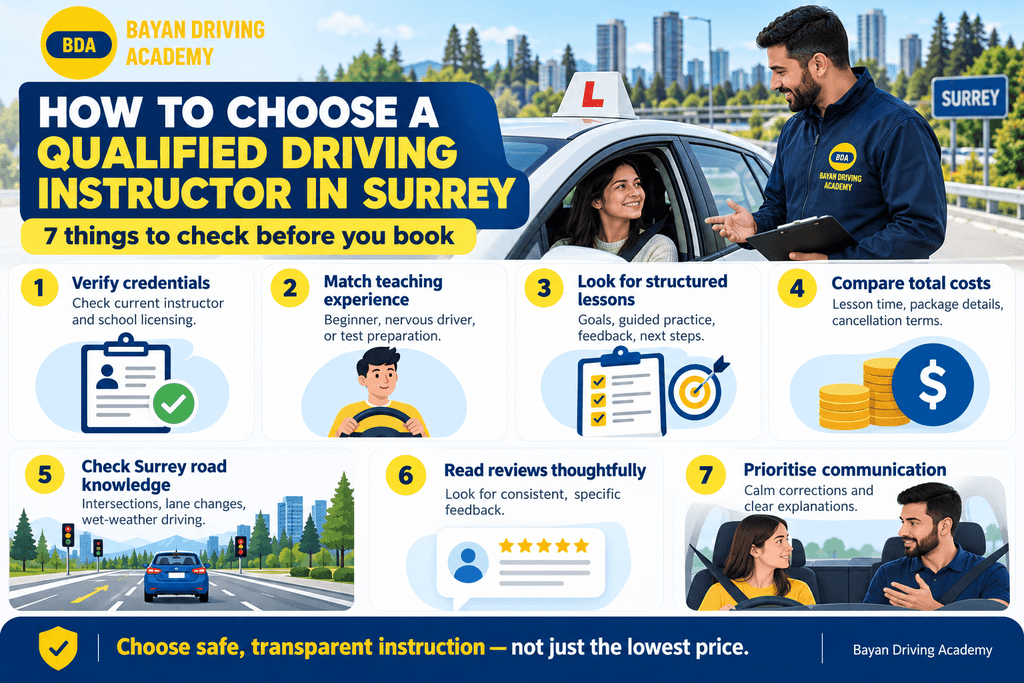
The first step in choosing a driving instructor is to verify that the person is properly authorised to provide driving instruction in British Columbia.
A professional appearance, friendly personality, or attractive website does not establish that an instructor is qualified. Learners should confirm the instructor’s credentials before paying for a package or beginning lessons.
Consider the following checks:
You can consult the official ICBC website at icbc.com to find information about driving instructors, driving schools, licensing requirements, and road tests.
Do not assume that a school is properly licensed simply because it has positive online reviews. Verify the relevant credentials independently.
An appropriately licensed instructor meets an important professional requirement, but teaching ability also matters. Someone can understand driving rules without necessarily explaining them in a way that a beginner finds easy to follow.
During your first conversation, ask how lessons are structured, how progress is assessed, and how the instructor handles repeated mistakes.
A strong answer should explain a clear learning process rather than promise that every student will pass after a fixed number of lessons.
Driving instructors work with people who have different backgrounds, abilities, and concerns. A first-time driver needs a different approach from someone who has driven overseas or someone returning to driving after several years.
When comparing a professional driving school Surrey learners may consider, ask whether its instructors can adapt their teaching methods to your experience level.
New drivers usually need to build foundational skills, including steering, braking, vehicle positioning, mirror use, shoulder checks, and speed control.
A suitable instructor introduces these skills gradually. Rather than immediately focusing on busy roads, they should establish basic control and observation before increasing the difficulty of driving situations.
Some learners understand the rules but become anxious when approaching intersections, merging into traffic, or driving alongside larger vehicles.
An effective instructor identifies the source of the anxiety and provides manageable practice opportunities. For instance, a learner who finds lane changes stressful may begin by practising mirror checks, signalling, and shoulder checks on quieter roads before progressing to busier routes.
The purpose is to build competence through repetition, not to dismiss the learner’s concerns.
Learners who already have driving experience may need targeted coaching rather than a complete beginner’s programme.
Their instructor can assess observation habits, speed management, intersection decisions, parking accuracy, and consistency. The lesson plan should focus on demonstrated weaknesses rather than spending unnecessary time repeating skills the learner has already mastered.

Someone with previous driving experience in another country may be familiar with vehicle control but less familiar with local road signs, intersection rules, speed limits, or testing expectations.
A good instructor explains these differences clearly and checks that the learner can apply the rules in real traffic.
Practical tip: Ask for an initial assessment of your current skills. A personalised starting point can make lessons more productive and help you understand where your practice time will be most useful.
Not all driving lessons offer the same learning experience. The number of minutes spent behind the wheel is important, but the quality of those minutes matters just as much.
When researching Driving lessons Surrey options, find out how the instructor plans, delivers, and reviews each session.
1. A clear objective
The instructor explains what you will practise, such as improving intersection observations or maintaining a safe following distance.
2. Guided practical practice
You practise the relevant skill in suitable conditions while receiving instructions and feedback.
3. Constructive feedback
The instructor explains what went well, what needs improvement, and why a particular adjustment is necessary.
4. A practical next step
The lesson ends with a review of your progress and a clear recommendation for what to practise next.
An instructor should be able to explain how your driving is improving. This may involve noting recurring errors, assessing consistency, and deciding when you are ready for more demanding road conditions.
For example, a learner may complete a parallel park successfully once but still struggle to repeat it without guidance. The instructor should distinguish between occasional success and a skill that has become reliable.
This distinction is particularly important when preparing for a road test. Reliable observation, appropriate speed, safe decisions, and consistent vehicle control are more useful than memorising a single route or manoeuvre.
Price is an important consideration for students, families, and adults paying for their own training. However, choosing a school based entirely on its advertised hourly rate can lead to an incomplete comparison.
If you are looking for a cheap driving school Surrey or near by, compare the total cost and the services included rather than focusing only on the headline price.
| Pricing factor | What to check |
| Lesson duration | Does the advertised session include the full stated driving time? |
| Package inclusions | How many lessons are included, and what skills do they cover? |
| Vehicle arrangements | Is the training vehicle provided, and are any conditions attached? |
| Cancellation policy | How much notice is required to reschedule without a fee? |
| Additional charges | Are there separate charges for pickup, travel, or other services? |
| Payment terms | Are deposits, refunds, and unused lessons clearly explained? |
Request a written breakdown before committing to a package. This makes it easier to compare providers on a like-for-like basis.
An affordable driving school Surrey residents choose should provide clear pricing, appropriate instruction, and reasonable terms.
Affordable does not automatically mean low quality, just as a higher price does not guarantee better teaching. What matters is the value you receive for your money.
Consider two hypothetical options:
Neither option is automatically superior. The better choice depends on the actual services, instructor suitability, total cost, and your learning requirements.
Also remember that the lowest-cost lesson is not necessarily the least expensive route to becoming a safe driver. Repeated lessons without a clear learning objective may use more time and money than focused instruction.
Ask whether the instructor can recommend a suitable lesson frequency based on your current skills. Be cautious of anyone who pressures you to buy a large package before assessing your needs.
Learning to drive in the area where you expect to use your vehicle can help you prepare for the conditions you will encounter after obtaining your licence.
A knowledgeable instructor should be able to teach general driving principles using relevant local road environments, while adapting the lesson to your experience and safety.
Surrey’s driving conditions can vary considerably. A quiet residential street presents different challenges from a busy intersection, a commercial area, or a multi-lane road.
A lesson does not need to cover every type of road in one session. The instructor should introduce more complex situations as your skills improve.
Not necessarily. Familiarity with the general road environment can be useful, but learning to depend on one specific route is not a substitute for sound driving skills.
A learner should be able to apply observation, hazard awareness, and traffic rules on unfamiliar roads as well. Road test routes and conditions may vary, so ask whether your training focuses on transferable skills rather than route memorisation.
When looking for the best driving school in Surrey BC, prioritise an instructor who prepares you for a broad range of realistic driving situations.
Online reviews can help you narrow down your options, but they should be treated as one source of information rather than proof of instructional quality.
When researching a trusted driving school Surrey learners recommend, look for detailed feedback that describes the actual learning experience.
Look for recurring comments about:
A review that explains how an instructor helped someone improve their observation habits may be more useful than a short comment saying that the school is excellent.
Consider the overall pattern rather than relying on one unusually positive or negative review. Reviews can be incomplete or subjective, and individual experiences may differ.
Before choosing Bayan Driving Academy or another provider, ask questions such as:
A professional school should answer reasonable questions without making you feel pressured to purchase a package immediately.
Communication is an essential part of driving instruction. Learners must be able to understand directions, ask questions, and receive feedback without becoming unnecessarily distracted.
An instructor who gives confusing directions or criticises mistakes without explaining how to correct them can make learning more difficult.
Suppose a learner approaches an intersection too quickly. Simply saying, “That was wrong,” does not explain how to improve.
A more constructive instructor might explain that the learner needs to scan the intersection earlier, assess the traffic conditions, adjust speed appropriately, and prepare to stop if required.
The instructor can then demonstrate the process, guide the learner through another attempt, and gradually reduce assistance as the skill improves.
This approach connects feedback to a specific action and gives the learner an opportunity to apply the correction.
During an introductory conversation or first lesson, consider whether the instructor:
You should feel comfortable asking questions, but lessons should remain focused and professional. The instructor must be able to intervene appropriately when safety requires it.
When selecting a driving school, learners should look for a provider that takes a structured, safety-conscious approach to driver education.
At Bayan Driving Academy, prospective students should clarify the available lesson options, instructor arrangements, pricing, and scheduling before booking. This helps establish whether the school’s services suit their experience, availability, and learning objectives.
A sensible learning process starts with understanding your current ability and identifying areas that need attention.
For a beginner, that may involve vehicle controls, basic road positioning, observation, and turning. For a more experienced learner, the focus may be on consistent mirror checks, safe gap selection, parking, or improving decisions at complex intersections.
Rather than measuring progress only by the number of lessons completed, focus on whether you can:
These are meaningful indicators of development, although progress varies from one learner to another.
No responsible driving school should guarantee a road test pass or claim that every learner will become test-ready after a fixed number of sessions. Readiness depends on prior experience, practice, individual progress, and performance across a range of driving situations.
For anyone comparing a professional driving school Surrey residents can consider, transparent communication and a commitment to genuine skill development are useful selection criteria.
Even well-prepared learners can make avoidable mistakes when comparing schools. Understanding these pitfalls can help you spend your time and money more effectively.
A low advertised rate may not tell you how much useful instruction you will receive. Compare lesson duration, instructor suitability, cancellation terms, and total package cost before deciding.
Road test outcomes depend on the learner’s performance and circumstances. A promise of guaranteed success should not replace a careful assessment of teaching quality, safety, and realistic preparation.
A large package may be suitable for some learners, but it is not automatically the right choice for everyone. Understand the terms and, where possible, assess the instructor’s teaching approach before making a substantial commitment.
Driving lessons require coordination between the learner and instructor. Clarify how much notice is required, what fees may apply, and whether missed lessons can be rescheduled.
Test preparation is important, but the purpose of driver education extends beyond examination day. A learner who passes should still be able to recognise hazards, manage unfamiliar situations, and make safe decisions independently.
Where legally permitted and appropriately supervised, additional practice can reinforce the skills learned during professional instruction. Confirm the applicable learner-licence conditions before practising outside lessons.
Professional lessons and suitable supervised practice can complement one another, but practice should never take place outside the conditions permitted by your licence.
Choosing a suitable instructor is only part of the process. How you prepare for and participate in each lesson can also influence your progress.
Tip 1: Set one or two priorities before each lesson. If you regularly struggle with observation at intersections, tell your instructor. A clear objective makes it easier to evaluate improvement.
Tip 2: Ask for explanations, not just corrections. Understanding why a manoeuvre is unsafe helps you apply the same principle in a different situation.
Tip 3: Keep track of recurring mistakes. Note areas such as late signalling, inconsistent speed control, or missed blind-spot checks. Discuss these patterns with your instructor.
Tip 4: Practise consistency rather than chasing perfection. One successful parallel park does not mean the skill is fully developed. Repeat the manoeuvre until you can perform it safely and reliably.
Tip 5: Be honest about your confidence level. If merging into traffic or navigating busy intersections makes you anxious, tell your instructor. Appropriate practice can help you build confidence without skipping essential steps.
Tip 6: Review your progress periodically. Ask what has improved, which weaknesses remain, and what you should work on next. This helps keep lessons purposeful.
Tip 7: Do not rush the learning process. Your readiness matters more than an arbitrary deadline. Develop the skills you need before progressing to more challenging situations.
These habits can make your training more focused and help you get greater value from every lesson.
Choosing a qualified instructor requires more than comparing prices or reading a few reviews. You should assess licensing, teaching experience, communication, lesson structure, local road knowledge, and the transparency of the school’s terms.
For learners researching The best driving school Surrey, the strongest starting point is to identify a school that prioritises safety, provides clear feedback, and adapts its teaching to your progress.
Finding an affordable driving school Surrey learners can feel confident choosing does not mean settling for the lowest price. It means understanding what you are paying for and selecting instruction that supports long-term driving competence.
Bayan Driving Academy encourages prospective learners to ask questions, understand their options, and choose training that matches their experience and goals. Before booking, confirm the available services, instructor credentials, lesson arrangements, and pricing so you can make a well-informed decision.
Start by checking the school’s licensing arrangements and the instructor’s credentials. Then compare lesson structure, teaching approach, pricing transparency, reviews, and scheduling policies. Ask how the instructor assesses your ability and adapts lessons to your weaknesses. The right choice is the school that meets your learning needs and helps you develop safe, independent driving skills rather than relying on promotional claims alone.
Compare the total cost of lessons, not just the advertised hourly rate. Check lesson duration, package inclusions, cancellation charges, and any additional fees. An affordable option should offer clear terms and suitable instruction without requiring you to purchase more lessons than you need. Before committing to a large package, ask whether you can discuss your requirements or arrange an initial assessment.
There is no universal number that guarantees readiness. A learner with previous driving experience may need less instruction than a complete beginner, while someone who struggles with observation or decision-making may need additional practice. Your instructor should assess your skills and recommend further lessons based on demonstrated progress. You should be able to manage common road situations safely and consistently rather than relying on memorised routes or frequent prompts.
Ask about their current instructor credentials, lesson duration, training approach, vehicle arrangements, pricing, cancellation policy, and experience teaching learners at your level. You should also ask how they identify weaknesses and measure progress. Their answers can help you determine whether their teaching style suits you. Avoid relying solely on guarantees about passing a road test, as individual results cannot be assured.
Professional instruction and supervised practice with an eligible family member can serve different purposes. A qualified instructor can provide structured teaching, identify errors, and explain road rules and driving techniques. Additional supervised practice may help reinforce those skills, provided the supervisor and learner meet all applicable legal requirements. The most appropriate approach depends on your circumstances, experience, licence conditions, and access to suitable supervision.

How to Pass Your Driving Test First Time in Surrey
How to Choose a Qualified Driving Instructor in Surrey
Driving Academy in Surrey for Safe, Confident & Skilled Driving


